Showing posts with label nature. Show all posts

Thursday, 28 May 2015

Rewilding- Part One

Last month I went to a talk at the University of Leeds all about rewilding in the UK. The talks were given by George Monbiot and Alan Watson-Featherson.

George described how although there are many upland reserves in the UK, they are only maintained to have the lowest level of biodiversity. This is because many years ago, someone decided that heather and scrub should cover most of the land despite the fact that forests would have historically covered these areas. To prevent the regrowth of the forests, sheep were used to over graze the land along with burning and cutting. George found that this is a problem all over the country as in lowlands there are few trees, but, in the uplands, where they would naturally be more, there are even less.


Thursday, 14 May 2015

Good News For Some Ecosystems- Sri Lanka

Sri Lanka have become the first nation to comprehensively protect all of the mangrove forests.


This great news has even more importance than most people think. Mangroves sequester far more carbon than other forests and the carbon is sequestered for a much longer period of time compared to your normal forests. Along with this, the mangrove tree root system provide nurseries for many fish species that go on to populate coral reefs, a beautiful natural wonder. These fish also provide jobs to the local fisherman who require the fish to provide an income.

Friday, 6 March 2015

Snowdrop Walk at Rode Hall

Last weekend I visited Rode Hall, the home of the Wilbraham family, situated in between Congleton, Kidsgrove and Alsager.


The house is beautiful but at this time of year it's the grounds that are magical as the gardens are covered with Snowdrops. Although there are no native species of Snowdrops in the UK, there are still 20 species worldwide but most are endangered. On the walk around the gardens you will get to see a variety of species, all of which are beautiful.

It costs £4 to get in but it is definitely worth it as you can get in touch with nature whilst being in a beautiful surrounding.


The walk down to the boathouse is highly recommended and the coffee shop at the end has some amazing cakes and drinks to warm you up after your walk.


The Snowdrop walks are only open till this Sunday 8th March but I would highly recommend a visit. To find out more click here.


Have you gotten in touch with nature in your area? Are there any nature walks around you?

Love

Thursday, 5 March 2015

Nature's A Bitch

This post was not one that I ever wanted to write, but sadly I felt I needed to.

We all know that nature is cruel, to those who don't think that, just consider that  only half of the new born gazelles born in Africa will survive their first year of life, or that many bird species have 2 chicks and leave the one that hatches second to die from starvation as that chick was only a back up (I saw this in the Galapagos Islands).

Knowing nature is cruel seems to just come with the territory but having sad news twice recently made me wish to tell you all.


Firstly 2 of the baby vervet monkey babies that I was following when in South Africa have died. I am so thankful not to have been there to discover this, because, from following them every day, you fall in love with their little personalities. It is not known what happened or when, just that one morning 2 were missing.


The more heartbreaking news is that on Tuesday afternoon our baby East Africa Rhino calf Fara at Chester Zoo also passed away.


Everything was done to try and save her when she started appearing ill in the morning but sadly there was nothing the team could do.


I am unbelievably honored to have been able to see such a rare part of nature, however sad at the outcome. From  the day that Fara was born until we were told the sad news, she brought a smile to everyone and excitement to many that have never gotten to see something so amazing and small.

Knowing that there really was nothing that anyone could have done to help her makes it harder in some ways, but, nature is a bitch and even a birth in captivity does not mean that the baby will survive.

image from ChesterZoo.org
To all those who sadly never got to see little Fara, its a great shame, but, it just means that we all need to work harder at preserving these species in the wild so that maybe in the future, you can be seeing them where they belong!


Love

Tuesday, 24 February 2015

Getting in touch with nature


Recently I was thinking about how I love to live in green areas yet often don't spend enough time exploring them! So this year I have decided to find out a little more about where  I live and whats on for people to get involved in.

Sunday, 25 January 2015

Finally Some Good Tiger News- Part 1

So, in the past week there appears to have been some great tiger news starting with the fact that in the recent tiger census completed in India, it is believed that the populations of tigers has increased by nearly 30% in the past 4 years which is an amazing.

Saturday, 10 January 2015

Wildcat and Tiger Trades Increasing

I haven't posted about nature in the news for what feels like forever but this story, just after I returned from Africa, really caught my attention.


It has been found that from a survey conducted over the past two decades, that the trade of tiger and wildcat parts from  Myanmar (Burma) into China in recent years is growing. The fact that the sale of these animals is still increasing is a dying shame because soon there really will be none of them left to sell.

Saturday, 19 July 2014

Field Course Fun

A few weeks ago I was on my last module of the year, a field course at the National Trust's Malham Tarn. Field courses that I had previously been on were been exhusting! Trying to cram in a huge volume of work into a week is always going to be tough but this time instead of it feeling super stressful the whole week was thoroughly enjoyable!
A view of Malham Tarn

After the 5km walk from the centre of Malham to where we were staying, the large National Trust house, we all arrived a little low in energy. After a short break and food we were split into our project groups which had been decided back in May, and, after discussing what we wanted to do with our supervisor we were allowed to relax.

I worked on bat emergence and following behaviour whilst on the field course which meant that the group I was in had to spend an hour our so out from sunset to count how many bats emerged and at what time. We also looked at if bats emerged closely together and if they did, did they follow each other. Although other projects appeared to be a little more time consuming in terms of data collection, I felt like the huge numbers of midgey bites I obtained made up for it.

In the days we had mini projects that we had to do over the course of the week and it was our choice how we decided to distribute our time. The projects included identifying tree species, observing birds and using coordinates to identify specific flowers. It was the mini tasks which enabled us to really get involved with what we were doing and learn so much more than if we had just been forced to write a report. This was because you were finding out things independently.
Along with all work that we had to do we got to take part in bird and bat netting, allowing us to catch the species and examine them closely which was incredible.
A baby bluetit

The entire field course enabled us to learn so much whilst specialising in things that we found interesting which meant you always put all your effort into the activities. Sadly we didn't get to go caving as the weather was to unpredictable but we did get to take part in a treasure hunt, in which my team came second after a HUGE amount of running around.

On the last day we all had to give our presentations about  our mini projects which was a little daunting but a great experience and then we got to have a fun quiz on pointless information.

Over all this was without doubt the best field course I have gone on so far and would recommend it to anyone at Leeds who is debating going on it!


The field course members


Sunday, 4 May 2014

Prehistoric Shark Caught

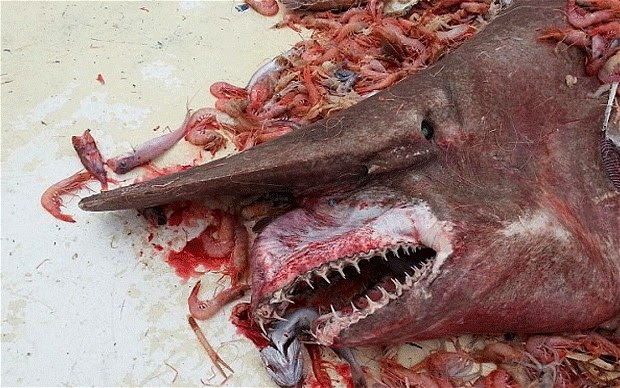
Shrimp fisherman at Key West, Florida, accidentally caught themselves a Goblin Shark recently. Goblin sharks are a prehistoric species which haven't been seen in over 10 years! The species can be found all over the world but is believed to mainly live around Japan which makes this catch so rare! The fisherman took a few pictures and released the thrashing shark back into the ocean where it could dive back to its home, over 200m below water, and only reported their findings to the National Oceanic and Atmospheric Administration 2 days ago.

So what does a Goblin Shark look like?


The Goblin Shark, razor teeth and a extendable jaw


This species is huge. The one caught was 18ft long and they have unusual pink skin. In the deep water, where the animals live, only red light is visible. At those depths the species will actually appear black to the eye. The head of the shark has a very large snout, like a sword, which allow it to detect minute electrical fields and catch prey quickly with its extending jaw  and large razor sharp teeth. Their bodies also appear fairly flabby and they have smaller dorsal and ventral fins compared to those of other shark species. This means that these sharks are not able to move as quickly as some other species.


To read more:
http://en.wikipedia.org/wiki/Goblin_shark
http://www.bioone.org/doi/abs/10.1656/1528-7092%282002%29001%5B0189%3AFROTGS%5D2.0.CO%3B2
http://www.dailymail.co.uk/news/article-2619301/Thats-no-shrimp-Florida-shrimp-fishermen-accidentally-net-second-prehistoric-goblin-shark-thats-18-FEET-LONG-pink-pointy-teeth.html


Tuesday, 1 April 2014

Whaling Ban!

Finally Japans 'experimental' whale hunting has  been banned!! After nearly 4 years since the case was first brought to light, the International Court of Justice ruled that the Japanese government must halt the whaling programme that they claim is for research in the Antarctic.

The ruling is binding and the Japanese are apparently feeling like Australia are trying to impose their cultural normality on the country and still argue that they have done nothing wrong.
In 1986 Japan signed up to the moratorium on whaling but continued  to whale in both the north and south Pacific claiming that they were undergoing scientific research. The whales being hunted are found in the Southern Ocean Whale Sanctuary, a 50 million square km area round the Antarctic which is against commercial whaling but does allow scientific research. The scientific output from the whaling in Japan has been minimal though, and many people feel like the government has been using the idea of research for illegal hunting. This became even clearer to some, as the slaughtered whales meat has been found to be commercially sold in Japan.

This ban is great news for whale conservation and will mean that species such as the Minke whales will be able to continue to grow in numbers and thrive in the ocean, but it doesn't ban whaling in North Pacific, so the Japanese can still sadly use the same loophole. If they are also able to find a better research proposal they maybe allowed back into the Southern Oceans eventually, but for now, and the near future, at least ocean giants are safer than they have been in a long time.

To read more ...
http://www.bbc.co.uk/news/world-asia-26818863
http://www.theguardian.com/environment/2014/mar/31/does-japans-research-whaling-help-conserve-whales

Monday, 3 March 2014

Is it bed time yet?


Ever wondered what animals do when they sleep?   A myth busting program called Animals at Night: Sleepover at the Zoo is on tonight at 21.00 on BBC4 to attempt to answer some of the puzzling questions about how animals sleep.

I hope that it will leave me with some great new facts to bust out with at random times but if not its bound to be another great BBC natural history documentary for you to pass the time watching.

To read more about what you can discover from the show view the link below, BUT it may spoil the great surprises if you read it before watching. You have been warned....

http://www.bbc.co.uk/nature/26353141?ocid=socialflow_facebook

To get you in the mood here are some pictures of our sleepy friends.


Monday, 17 February 2014

Werewolves

I have seen many animals, but nothing quite like this species of cat called Lykoi. They look like little werewolves which I reckon could have some movie fans going wild, especially if you're a Wolverine fan
.
The feline species have no hair around their eyes, nose or mouth and are said to act a lot like dogs. The species arose from a natural mutation that occurs in the black domestic cat.
I still can't make my mind up whether or not I feel they are cute but I guess you can make up your own mind. Let me know what you think?

Do you want a cat that looks like a wolf, just like it name suggests or, is it just a little to far into the fantasy world for your liking?


Monday, 27 January 2014

The BBC does it again


There is nothing better than a natural history program that is different to all the rest. A new show called Hidden Kingdoms started last week and offers exactly this,  fresh look at nature!Instead of focusing on the big animals, it focuses on the animals in animal communities that are often forgotten, like the elephant shrew and the chipmunks. The series follows  their lives and the challenges that they face for being so small. This new look at the world is not just fascinating but also educational, enabling anyone to learn about parts of nature that occur below our feet. A word of warning though, , it also shows the harsh reality of the natural world as well!


You can catch up with the series on BBC iplayer.
http://www.bbc.co.uk/iplayer/episode/b03qkcgs/Hidden_Kingdoms_Under_Open_Skies/

Friday, 3 January 2014

Why Zebras Have Stripes

So just before Christmas the theory of why Zebras have stripes was finally settled (hopefully anyway). Scientists having been using computer models to simulate Zebras movement, the model discovered that the Zebras stripes cause optical illusions when the animals are moving. This helps confuse their predators and therefore helping to keep them safe. Although the stripes have thought to have many theories this is the first one that has been effectively confirmed. The scientists believe that the stripes may lead predators and insects to think the animals are moving in a different direction to where they are really going.

It really does give a new meaning to the idea racing stripes if your opponent thinks you're going the other way now doesn't it!


For a little more detail..
http://www.bbc.co.uk/nature/25260311